Sunday, November 24, 2013

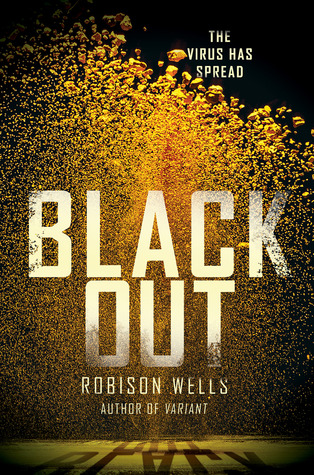
Blackout

114. Robison Wells, Blackout

BlackoutI really enjoyed this book--set in a not-so-distant future, a group of teenage terrorists has been attacking targets all across the US, targeting valuable infrastructure, tourist landmarks--anything to raise fear levels. When it becomes apparent that these terrorists possess uncanny abilities, and these abilities are related to a virus that only targets teens, the US government responds by rounding up *all* teenagers, and attempting to recruit those with useful powers. If it sound vaguely X-men-ish, well, it is. But still highly enjoyable for that (or maybe because of that).

The story follows four characters: Alec and Laura, who are part of a terrorist cell, and Aubrey and Jack, former friends who attend a small town high school in rural Utah. Jack is a typical poor kid; Aubrey used to be just the same until she discovered that she could turn invisible--and got recruited by the most powerful girl in the high school. Aubrey's rise to popularity caused a rift between the two, but when both are taken to a government camp, Aubrey pledges to stay with Jack. But when the unthinkable happens and Jack gets sorted into a high-power camp for kids with the virus and Aubrey is let loose, Aubrey risks her life and freedom trying to save Jack.

I've read some reviews that suggest that the alternating POVs get confusing--I never found them so. In fact, I liked getting into the mind of the three characters, though obviously I connected more to Aubrey and Jack than Alec and Laura. The book is setting up a series, so not everything gets explained or resolved in this book (and having read Wells' previous books, I was pretty much expecting this). If I had a complaint, it might be that--as with Variant and Feedback--the focus on an intense, quick-paced plot sometimes overshadows character development. Aubrey was probably the most fleshed-out character here, but all of them could have used a little more depth.


Wednesday, November 13, 2013

Solstice Magic

Solstice Magic (A Calgary Stampede Adventure, #1)113. Solstice Magic, by Jean Stringam

This book was unlike anything I've read in a long time--in both good and bad ways.

To start: I absolutely loved the setting--a behind-the-scenes look at the Calgary Stampede (rodeo) in Canada. I loved, too all the bits of Ukranian culture the author threw in. The author's writing style also had some lovely and unexpected phrasings.

The plot itself is a little harder to capture. The story opens with a scene at the Stampede, of a bull rider meeting a petite rodeo clown for the first time and realizing that there's something unusual, even magical, about the clown. But then it takes another fifty or so pages to get back to the bull rider and clown. Instead, the story plunges us into the story of Zo and her parents, and how their lives are disrupted by the arrival of Zo's Baba Dolia (and her over-sized pet with killer instincts) from the Ukraine.

Zo's friends and neighbors (Jaki, Ivan, and their own baba, also Ukranian) try to help Zo make sense of her baba's tendency to disapprove of everything Zo does, particularly her obsession with her new rabbit, Susie Lago. But when Susie mysteriously disappears on the night of Solstice and Zo blames her grandma (and her grandma's dog), the two stories start to intersect. I have to admit, the way the stories intersected surprised me, I think in a good way.

But I found the tone to be a little strange. When we initially got to Zo's story, I assumed she was about ten, from the sound of her voice. So I was surprised (unpleasantly this time) to find that she was actually in high school. I think she consistently acts younger. I was also a little disconcerted initially by all the point of view shifts, including the rabbit's (she's determined to be an Easter Bunny).

So not everything here worked for me, but I thought it was worth reading for the intricate setting. And there were some passages near the end from the point of view of Baba Dolia that I thought were sad and lovely and moving. 

Sunday, November 10, 2013

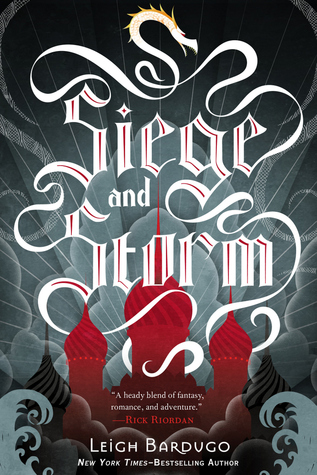
Siege and Storm

112. Leigh Bardugo, Siege and Storm.

Siege and Storm (The Grisha, #2)I fell in love with Bardugo's Grishaverse in Shadow and Bone, and found much to love in the sequel. It's not perfect, but it's a great sequel and continues a lot of the themes of the first one. Alina and Mal think that they are safely away from Ravka and the reach of the Darkling in a new land. But they find that they cannot run for long, and that the Darkling is far more powerful than they give him credit for.

Brought back (largely against their will) to Ravka, Alina finds that she will  need to summon new reservoirs of power to help fight against the Darkling and lead an army of Grisha against him. But the very power she needs also drives a wedge between her and Mal.

What I love about this series: I love the richly imagined world and the Russian feel of Ravka. And I love that Bardugo doesn't shy away from making Alina make hard choices. I love that Alina herself is complex: sometimes shy, sometimes driven by desire and longing, sometimes funny, often conflicted about what she wants for herself. I don't always love Mal (truth is, I secretly prefer the Darkling, immoral though he might be). And in this new book, I love the new character of Prince Nikolai.

This book is dark, though--and as the second in a trilogy, it definitely does not have happy ending. I really enjoyed it, even if I didn't love it as much as the first book. It's not a perfect book (the middle is slow in parts and sometimes the relationship drama is a bit much), but it has so many good things going for it that I can forgive those.

Sunday, November 3, 2013

Fragments

111. Dan Wells, Partials.

Fragments (Partials, #2)Lately I seem to have a bad habit of picking up sequels without having read the original book--after reading Fragments, I definitely feel I need to go back and read Partials.

I'm feeling lazy today (also, this book had a complicated plot), so here's the summary from Goodreads:

Kira Walker has found the cure for RM, but the battle for the survival of humans and Partials is just beginning. Kira has left East Meadow in a desperate search for clues to who she is. That the Partials themselves hold the cure for RM in their blood cannot be a coincidence—it must be part of a larger plan, a plan that involves Kira, a plan that could save both races. Her companions are Afa Demoux, an unhinged drifter and former employee of ParaGen, and Samm and Heron, the Partials who betrayed her and saved her life, the only ones who know her secret. But can she trust them?

Meanwhile, back on Long Island, what's left of humanity is gearing up for war with the Partials, and Marcus knows his only hope is to delay them until Kira returns. But Kira's journey will take her deep into the overgrown wasteland of postapocalyptic America, and Kira and Marcus both will discover that their greatest enemy may be one they didn't even know existed.


My take: I thought the book was incredibly well done. It did drag a little in a couple of parts, but given that Kira travels from the East Coast to Colorado, that's not entirely surprising. But mostly I found the novel to be clearly written, fast-paced, and the world built was amazing. Most of the time I find post-apocalyptic stories to be a little depressing or predictable big-brotherish. This was neither. In addition to good storytelling, the book also raises interesting ethical questions about humanity and to what extent it is ethical to save oneself at the expense of others.

Wednesday, October 30, 2013

Chameleon

Chameleon (Supernaturals, #1) 110. Kelly Oram, Chameleon

I like a good supernatural novel every once in a while (I'm a huge fan of Patricia Briggs' books), and I enjoyed Oram's novel, V is for Virgin. Oram has a great, snappy writing style that's perfectly suited for YA.

That said, I didn't love this book as much as I'd hoped to. Dani Webber is an ordinary girl--a little on the rebellious side, with just one really close friend (a guy)--but she doesn't think there's anything too unusual about that. Until, just after she turns sixteen, her best friend Russ reveals that he's a warlock . . . and then Dani herself stops time at a dance.

Turns out, nothing Dani thought about herself or her life is real. After a werewolf shows up to abduct her, Dani reluctantly agrees to turn herself over to the Council, who regulate supernatural activity. The Council promises to protect her and train her--but after they betray her trust, Dani finds herself struggling to know who to trust:  Russ and his father, Alex, who always treated her like his own daughter, but lied to her for years about her ability? Or the Council who only seem interest in using her unique powers--and who forced her into a marriage against her will to the gentle Seer, Gabriel? Still more questions rise when both Dani and Gabriel see visions of someone trying to raise the Angel of Death (a powerful demon), and they have to unite to try and stop this from every happening.

The plot really has some interesting and engaging ideas. I think what I struggled with was that some of the elements were just too much. The love triangle, for instance. Oram does such a great job making you care about Russ, that when Gabriel gets introduced, it's hard to love him as much--particularly when Dani's situation with Gabriel is something imposed on both of them from the outside. There were also some major plot twists that I saw coming.

The book does read quickly, and, as mentioned above, Oram has a great YA voice. The book is worth reading for the interactions between Dani and Russ alone. So if you have a reasonably high tolerance for dramatic love triangles, you'll probably really enjoy this book. I couldn't get into the love triangle, which ultimately made the book less enjoyable for me.

Monday, October 28, 2013

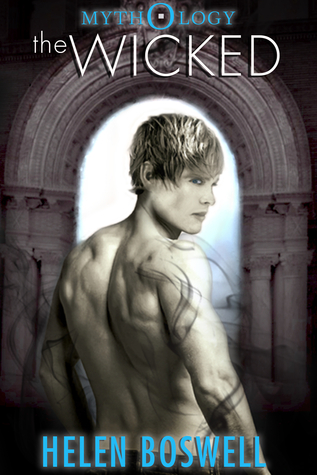
The Wicked

109. Helen Boswell, The Wicked

Mythology: The WickedI was lucky enough to read bits of this as Helen was writing it, but I was thrilled to find out that the whole was much greater than the sum of its parts (and the parts themselves were quite good). This is a sequel to Helen's Mythology, but I think this is one of those unique cases where the sequel is even better than the first novel.

The book opens with Hope and Micah struggling to find a way for Micah to live with his demon status; Micah's values mean that he refuses to steal souls from others, but without this energy, he will die in a matter of years. At the same time, they're drawn into a local conspiracy as young demon boys keep surfacing, dead. As the two struggle to solve this mystery, Hope continues to master her own powers and Micah finds himself as a pawn in still another power-struggle, this time with the powerful Praxidikai, who strive to maintain balance between demons and guardians. All of this sounds like it might be too much, but Helen does such a great job weaving together different storylines.

And at the heart of it all is Micah's relationship with Hope. Where book 1 was from Hope's perspective, book two interweaves Hope and Micah's perspectives. And I have to say, I really love Micah. He's sweet, but real, which means he has flaws--and he makes mistakes with real consequences.

The story itself was fast-paced, the writing generally clean, and the romance itself had some definitely swoon-worthy moments. I really enjoyed this--and I can't wait to read book three! (No pressure, of course, Helen . . . )

Monday, October 21, 2013

Blackmoore

108. Julianne Donaldson, Blackmoore

Blackmoore: A Proper Romance I loved Donaldson's debut novel, Edenbrooke, so I was thrilled when my sister loaned me her copy of Donaldson's newest book. And while I'll admit that I like Edenbrooke better, Blackmoore kept me entertained for the last couple of days--and it fulfilled really the only requirement I have for a good romance novel: at some point, my  heart has to hurt. And Blackmoore did that for me.

The story opens with Kate Worthington fretting about an upcoming trip to Blackmoore, the estate caught between the sea and the moors that will someday belong to her childhood friend Henry. She's dreamed about this trip almost her whole life, but now, through her mother's manipulativeness, she may be denied this visit. Desperate to go--and more, to go to India with a maiden aunt after the trip is over--Kate makes a bargain with her mother: she will receive (and reject) three proposals of marriage, or else she will do whatever her mother commands her. Granted, this agreement seems sort of silly (Kate herself realizes quickly how foolish it is), but if you can suspend your disbelief of that for a while, it helps engineer some of the most interesting tension of the novel.

The novel is a little slow getting going, as we only gradually realize why Kate is so set against marriage through a series of flashbacks in the middle of the story. This novel is darker than Edenbrooke, as Kate's family is particularly wretched. Maybe the setting lends itself to that impression too, as the moors encourage Kate to a wildness she didn't realize she had.

I liked the central tension between Kate and the main love interest (I won't name names, though it's pretty clear early on who this will be)--but I loved the setting. And, as an amateur birder myself, I loved the recurring bird motif throughout the book. I didn't love the ending, which seemed to resolve pretty quickly (particularly in comparison with how slowly the early part of the book unfolded), but the romance itself was satisfying to me.